

Spot the Scammer
Details you don't often hear about during qualitative research

Welcome to a rerun of Shine in the Margins! Now that it’s summer, I’m taking a much needed break. Other than the occasional summer post about what I’ve been up to, you’ll be seeing posts that I loved to write, posts that you may have missed, and ones you enjoyed reading. I’m not too far though. You’re welcome to join the Academic Support Hub, a free space for current graduate students.
Surviving COVID changed how qualitative PhD dissertations can be done.
The following post is about my experience when I started data collection in the summer of 2023.
When it comes to research, you’ll usually hear about the beginning and the end, but rarely the process.
Or, if you do hear about the process, it’s at the end, after everything’s all wrapped up with a nice, shiny bow. Unless you’re friends with a PhD student or follow someone on Instagram and they tell you what they’re going through.
But even then, sometimes, the nitty gritty details aren’t openly discussed.
And I get it. I wasn’t planning on sharing the in-between publicly either.
I thought- no, I hoped that my research would go smoothly.
In my dissertation study, I’m interviewing students and faculty to gain insight on diverse perspectives in PhD programs. To participate in my study, people have to fill out a screening survey that has some eligibility and demographic questions. If they completed both the survey and interview, they received a $25 gift card. Recruiting students and faculty can happen a number of ways, depending on your preferred method. For me, I planned on using social media and my village (friends, colleagues, professors, etc.). Essentially, I was relying on my network to spread the word about my study.
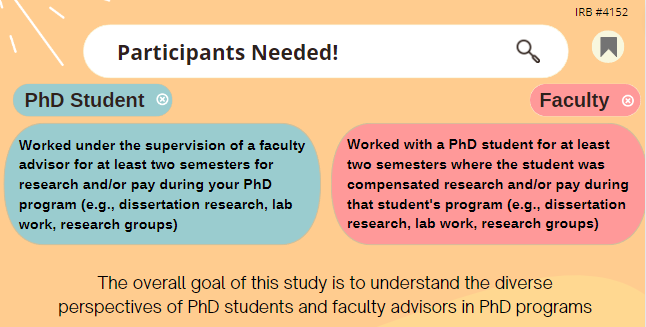
On the evening of Thursday, July 13th, I scheduled a LinkedIn post with my flyer for 8 AM the next day. I thought, “Who goes on LinkedIn that early?”
That morning, I dragged myself out of bed and set off for my hour-long commute to work. When I got to my desk at 8:30 AM, I pulled out my personal laptop and logged into my Outlook, curious to see if anyone responded yet. Over 50 people signed up for my study! Emails were still rolling in as I scrolled to catch up! It got to the point where my calendar was completely booked and it was preventing faculty from signing up for an interview.
I was shocked, excited, then immediately started feeling overwhelmed and anxious. But my friends assured me this is a great thing to happen and I can do it. They said,
“This is proof that your study is important and novel. Everyone wants their story to be heard.”
After cancelling some of the interviews, I officially had thirty-four interviews scheduled. I was ecstatic. I would be done with data collection by mid-August and I would have the rest of the semester to analyze and write.
In interviews, usually the researcher has power (like the power to ask questions, control the interview, etc.). But for me, I always try to balance the power by reminding my contributor that they have the authority to not answer any questions they do not feel comfortable answering. If they share something potentially triggering or traumatic, I remind them they can take some time or space.

Then there’s the power that I never use, which is stopping the interview and pausing data collection.
I never imagined having to pause my interviews. Until I had a gut feeling that there was a suspicious pattern with the first four participants.
Participant 1:
It started with the first participant who came into the Zoom room. I was unsuspecting at the time.
They came with their camera off. I thought to myself, “Okay, that’s fine. They’re probably concerned with exposing their identity and feel more safe without their camera on.”
Participant 2:
Then I interviewed the second participant. They also had their camera off. I thought, “Oh it must be a coincidence.”
As we progressed through the interview, I noticed Participant #2 had some answers during the interview that contradicted their answers on the screening survey. Shortly after the interview, I asked them to retake the survey. I was disappointed to find his answers changed. Basic details like, how long he’s been in the program, his student citizenship status, even his religion.
Magically, he was in the program 3-4 years instead of 5-6 years. He was a domestic student instead of an international student. And suddenly he was a Catholic instead of Muslim!
Not only was his survey fishy, but after the interview ended, Participant #2 asked if I lived alone or with my parents, and if I’d ever want to visit Nigeria. I gave the benefit of the doubt thinking, maybe there were cultural differences as I was born and raised in the U.S. I thought he was just trying to make conversation.
With all those facts out in the open, I felt slightly discouraged, wondering if he was a scammer. But I carried on, thinking it was a fluke.
Participant 3:
I tried to quell my concerns by asking the third participant to verify basic details that they answered in the survey. They confirmed each detail and I proceeded with the interview.
After each of these interviews, I was exhausted as they all had Nigerian accents and I had to strain my ears to really understand so that I could listen and ask relevant follow-up questions. I didn’t mind the accents as I work with international students daily.
Participant 4:
By the fourth participant, I grew suspicious. Participant #4 also came in with their camera off, they had a Nigerian accent, and there was a ton of background noise. I asked the participant if they could move to a quieter area. They obliged and a few minutes later, asked if the noise level improved. But there was still loud music in the background.
At that point, I had a bad feeling and quickly suggested that we reschedule. Once Participant #4 agreed, we exited the Zoom room.
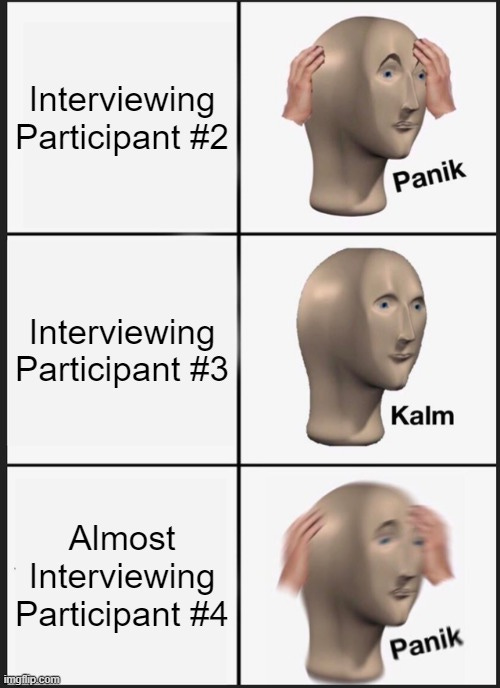
I was nervous and anxious. Something was off. I looked into the participants’ survey responses and found that the IP addresses indicated they all took their surveys in West Africa.
I couldn’t even fathom the idea that I had imposter participants. I needed a second opinion. I called my study auditor1 and without even a ring, she picked up.
“I didn’t want to text this because I’m going to sound like a jerk.”
She laughed and asked what was going on.
Shine in the Margins is a free, reader-supported publication. But if you believe this writing is valuable and want to contribute to a scholarship fund so that I can coach students pro bono, please consider purchasing a paid subscription.
I relayed to her all the potential red flags I noticed and she agreed that there was something off. She suggested I add a question asking for their .edu email address and have everyone, including the participants I interviewed, retake the survey.
Eleven people retook it. Out of the 11, two provided .edu email addresses. While everyone else still provided their Gmail address.
But regardless of whether I received an .edu email address or not, everyone’s answers changed. Basic details like field of study, U.S. region where they’re studying, even number of years they’ve been in the PhD program. One participant magically became a student even though their initial survey said they were a faculty!
Participant #4 suddenly went from 26-30 advisees in the past 3 years to 6-10! Instead of getting his PhD degree in Social Sciences in the U.S. West region, he suddenly got it in STEM in the U.S. South region!
As of posting this Substack, Participants 1, 2, and 3 have yet to retake the survey.
I had heard of scammers on surveys, but I didn’t expect scammers in qualitative studies like interviews. I never imagined someone to lie on a five minute survey and proceed to lie during an hour and a half interview all for a gift card.
Within a day of recruitment, I had 34 participants, and 30 of them were fake.
Going through all of the survey responses I got, out of the 150 I received, 144 of them were all taken in West Africa.
I was angry.
Imagine if I had already interviewed 20 people, only to discover that most of them were imposters? I would’ve wasted so much time and money. It likely would’ve set me back by a semester if I hadn’t caught it early.
But I also felt devastated and discouraged. I thought so many people were inspired and excited for my interview. They all leaped at the opportunity. But no, instead, I was preyed on.
I’m not annoyed or mad. But I’m a little bummed out.
Amidst the feelings, I took several steps to adjust and bounce back. Read this post to learn about what I did to resolve these issues.
Are you struggling with your advisor?
Academic advisors are rarely able to provide the level of support students need, and that’s why so many graduate students struggle.
As your alt advisor, our work together is my top priority! We’ll develop personalized strategies and systems of support so you can make progress at your capacity even when your advisor is no help!
In my methodology, I have an auditor who reviews my analysis to provide a fresh perspective and unbiased feedback.